

Table of Contents
- Why Card Stock Quality Matters for High-Volume Production
- Card Stock Printer Compatibility: Laser, Inkjet, and Digital
- Reduce Member ID Card Waste Through Testing and Quality Control
- Card Stock Storage Best Practices for Consistent Results
- Reliable Card Stock for High-Volume Workflows: What to Look For
- Frequently Asked Questions
Last Updated: October 12, 2026
Why Card Stock Quality Matters for High-Volume Production
When you're managing hundreds or thousands of membership cards, employee badges, or event credentials, reliable card stock for high volume production becomes your most critical operational variable.
The difference between premium and substandard card stock shows up in three places: printer compatibility, durability in the field, and total cost per finished piece. At Laser Member Cards, we work with organizations printing anywhere from 500 to over 1 million cards annually. Our consistent quality keeps customers coming back.
Card Stock Weight and Thickness: Understanding the Specs
Card stock specifications can feel overwhelming because manufacturers use multiple measurement systems simultaneously. Understanding the relationship between basis weight, point thickness, and GSM ensures you select material that works with your equipment and survives actual use.
Basis Weight vs. Point Thickness
Basis weight measures how much a ream of 500 sheets at a standard size (usually 20" x 26") weighs in pounds. A 100 lb basis weight card stock is heavier and stiffer than an 80 lb card stock. For high-volume production, basis weight directly affects how your printer handles the material: heavier stock requires more precise feed mechanisms and may need adjusted registration.
Point thickness, measured in thousandths of an inch (mils), describes the actual physical thickness you feel when you hold the card. For membership and ID cards, 7-13 mil thickness is the standard range for printing on laser and dry toner printers as well as on inkjet machines. A 7-mil card is noticeably thinner than a 10-mil card. We commonly hear of inkjets struggling with anything too thick therefore we recommend 7-8 mil cards for printing inkjet.

LMC1002 Two 10-mil Perforated Plastic Membership ID Card Paper - Laser Member Cards
The relationship between basis weight and point thickness is not linear. A 100 lb basis weight text stock and a 100 lb basis weight cover stock can have different thicknesses because cover stock is denser. When ordering card stock, always verify both measurements to ensure the material matches your printer's specifications.
GSM and Caliper Measurements
GSM (grams per square meter) is the metric equivalent of basis weight. A 148 GSM card stock is roughly equivalent to a 100 lb basis weight in the imperial system. GSM is increasingly common in printer manuals and technical specifications, so understanding the conversion helps you compare options.
Caliper is the direct measurement of thickness in millimeters or thousandths of an inch. A 0.25 mm card is 10 mil thick. Caliper is the most reliable specification for ensuring consistent printer performance because it directly reflects what your printer's feed mechanism encounters.
For reliable card stock for high volume workflows, consistency in caliper across an entire carton matters more than hitting a specific basis weight target. A 10 mil card that varies between 0.24 mm and 0.26 mm will cause intermittent jams. A 10 mil card that consistently measures 0.25 mm will feed smoothly through thousands of sheets.
Card Stock Printer Compatibility: Laser, Inkjet, and Digital
Not all card stock works equally well in all printer types. Laser printers use heat and pressure to fuse toner; inkjet printers spray liquid ink onto the surface; digital presses use a combination approach. Each technology has different material requirements.
Laser printers work best with card stocks that can withstand sustained heat (around 200°C) without warping or off-gassing. Synthetic polyester cards are engineered for laser compatibility and won't degrade under heat stress.

LMC8269-80N Two Card 7-mil Plastic Peel Out Laser Membership ID Cards
Inkjet printers need card stock with a receptive surface that allows ink to dry quickly without bleeding or feathering.
Digital presses combine laser and inkjet technologies and are generally the most flexible with card stock options. However, feed mechanisms on digital inkjet presses are often more sensitive to thickness variation than laser or inkjet printers. Consistency matters more than with other technologies.
The Xerox printer specifications for card stock compatibility outline maximum thickness and minimum caliper requirements for their laser printer lineup. If you're using Xerox, Canon, Ricoh, or Konica Minolta equipment, check the official documentation for your specific model before ordering bulk quantities.
Synthetic and Polyester Cards
Synthetic cards made from polyester are engineered for maximum durability. They resist water, fading, and physical wear far better than paper-based card stock.
For cards that will experience outdoor exposure, frequent lamination, or long-term use (12+ months), synthetic materials are worth the investment. For internal credentials or short-term event badges, paper-based ID cards are usually sufficient and more cost-effective.
LMC8269-80N Two Card 7-mil Plastic Peel Out Laser Membership ID Cards →
Polyester cards are compatible with inkjet printers when a special inkjet receptive film is applied tot he membership ID cards. Always verify printer compatibility before ordering.
Reduce Member ID Card Waste Through Testing and Quality Control
High-volume production creates waste at scale. A 2% jam rate on 10,000 cards means 200 damaged sheets. Testing and quality control processes catch problems before they multiply across your entire production run.
Request samples from Laser Member Cards and run them through your complete workflow: design, printing, cutting, and any finishing steps. Print at least 50 sheets to identify intermittent feed problems that won't show up in a small test batch. Check print quality, color consistency, and edge sharpness. Verify that cuts are clean and registration is accurate.
Document your test results, product SKU and keep the successful sample batch as a reference. When you reorder, include the product SKU with your purchase order to assure you order the product you tested.
Quality control during production catches defects early. Spot-check periodically throughout the run.
Card Stock Storage Best Practices for Consistent Results
Card stock absorbs and releases moisture based on ambient humidity. Changes in moisture content cause the material to expand or contract, which leads to registration drift, feed problems, and warping. Proper storage prevents these issues and ensures consistent results across multiple production runs.
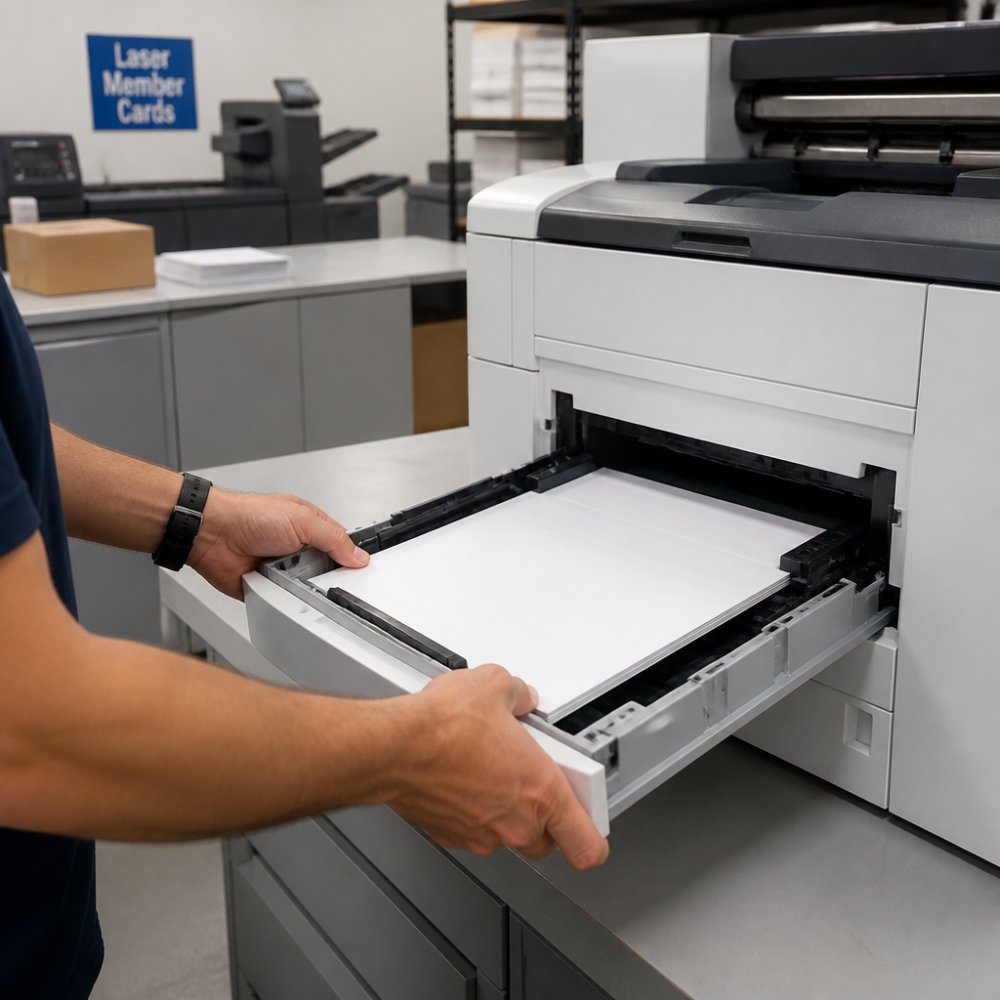
Store card stock in a climate-controlled environment between 40-50% relative humidity and 68-72°F. These conditions prevent the material from absorbing excess moisture or drying out. If your facility doesn't have climate control, invest in a storage cabinet with humidity regulation.
Keep card stock in its original packaging until you're ready to use it. The carton and wrapping protect the material from humidity fluctuations and dust. Once you open a carton, use the stock within a reasonable timeframe (typically within 2-4 weeks) before it begins absorbing ambient moisture.
If you've stored the membership ID card stock in variable conditions, allow it to acclimate to your production environment for 24 hours before running it through your printer. This gives the material time to reach equilibrium with the ambient humidity and reduces feed problems and registration drift.
Reliable Card Stock for High-Volume Workflows: What to Look For
Laser Member Cards sells reliable card stock for high volume production.
Consistency means the material performs the same way from sheet to sheet and from carton to carton. Our products maintain tight tolerances on caliper, basis weight, and moisture content.
Printer compatibility is non-negotiable. Our products are guaranteed to be 100% defect free and manufactured to spec. Each customer is responsible for assuring product performs as expected in their make and model of printer. Laser Member cards offers free consulting, free test samples and small 200-250 sheet packs at minimal cost for testing.
Laser Member Cards provides premium, USA-manufactured member ID card stock compatible with laser, inkjet, and digital printers.
High-volume card production demands materials engineered for consistency and reliability. Get started with Laser Member Cards and order your free test samples today.
Frequently Asked Questions
What card stock weight and thickness should I use for reliable high-volume printing?
For high-volume card production, 100# Digital Text or 90# Index (approximately 150-160 gsm) paired with 7-9 mil synthetic card material offers the best balance of durability and printer compatibility. This thickness prevents jamming during large production runs and ensures cards maintain their shape and appearance. Thicker cards are available and also reliable but might add labor time to the production run.
How does card stock printer compatibility affect high-volume production reliability?
Card stock printer compatibility directly impacts feed reliability and output quality in high-volume workflows. Laser printers, inkjet systems, and digital presses have different paper-handling mechanisms. Synthetic polyester cards tested on Xerox, Ricoh, Canon, and Konica Minolta equipment reduce jam rates and ensure consistent color and image quality across thousands of cards. Always verify your specific printer model before committing to bulk orders—request free samples from Laser Member Cards to test on your equipment first.
Can proper card stock storage and handling reduce ID card waste?
Yes. Storing card stock in climate-controlled environments (65-75°F, 40-50% relative humidity) prevents moisture absorption and warping, which cause jams and print failures. Keep cards in their original packaging until use, stack them flat, and avoid exposure to direct sunlight or temperature swings. Proper storage eliminates waste from environmental damage and inconsistent feed performance, directly lowering your per-card production cost on large runs.
What should I test before placing a bulk order for reliable card stock?
Request samples and run them through your actual printer equipment across multiple production cycles. Test both single-card and multi-up formats to confirm feed reliability, color consistency, and output quality. Check for jams, smudging, and ink adhesion. Run at least 100-200 test cards to identify any issues before committing to bulk quantities. This helps to ensure the stock meets your production standards at scale. Laser Member Cards offers small packs of 200-250 sheets for testing purposes. This helps customers run a reliable test without committing to a full carton or more.