

Table of Contents
- What Makes a Printer Ideal for Plastic Membership Cards
- Laser-Compatible Membership Card Sheets: Features and Benefits
- Laser Printers vs. Inkjet Printers for Card Production
- How to Print Membership Cards in a Small Office
- Printer Compatibility and Card Material Specifications
- Getting Started with Your Membership Card Printing Solution
- Frequently Asked Questions
Last Updated: September 25, 2026
What Makes a Printer Ideal for Plastic Membership Cards
Not all printers handle plastic membership cards the same way. The difference between a successful card production setup and one that jams constantly comes down to printer compatibility, card material thickness, and feed mechanism design.
A printer for plastic membership cards needs to handle synthetic materials without melting or warping them. Laser printers work best because they use heat that bonds toner to plastic without damaging the card substrate. Inkjet printers require special card stock with absorbent coatings to prevent ink from beading up. The printer's feed tray must accommodate thicker stock, standard office printers choke on anything over 10 mil thickness.

Image above showing the LMC8268-80N One Card 7-mil Plastic Peel Out Laser Membership ID Cards
At Laser Member Cards, we've spent over two decades providing card stock that works flawlessly across different printer types. The cards you choose determine whether your production runs smoothly or grinds to a halt mid-batch.
The key specifications that matter: card material (poly vs. paper-base), thickness (measured in mil), finish (matte vs. gloss), and whether the card is perforated or peel-off. Each combination performs differently depending on your printer's toner fusing temperature and feed mechanism.
Laser-Compatible Membership Card Sheets: Features and Benefits
Laser-compatible membership card sheets come in two main material types: synthetic poly cards and paper-base member ID cards with poly coatings. Each has distinct advantages depending on your durability needs and printer setup.

Image above showing the LMCPR1 One 10-mil Perforated Paper-Base Card Paper - Laser Member Cards
Synthetic poly cards are pure plastic, typically 7 mil to 13 mil thick, and they resist moisture, creasing, and fading. They're ideal for cards that will be carried in wallets, scanned repeatedly, or exposed to weather. The downside: they require precise printer settings to avoid heat damage, and some older laser printers struggle with the feed but they print beautifully in most modern laser / dry toner printers.
Paper-base cards use a paper core with a laser-safe poly coating. They're more forgiving in older printers because they don't require as much heat tolerance. They cost less than full synthetic cards but don't last as long in high-wear environments like gym memberships or outdoor event badges.
The best laser-compatible membership card sheets include perforated designs that let cards separate cleanly from the carrier sheet. This matters if you're printing in batches and need to hand-separate cards quickly. Peel-off designs work too, they're slightly faster to remove but leave a small carrier edge on back of the card.
Duplex printing (front and back) is standard on all membership card sheets sold at Laser Member Cards. The carrier sheet provides stability during printing, then you peel or tear the card away. This design prevents jams and ensures crisp, centered prints on both sides.
Laser Printers vs. Inkjet Printers for Card Production
The choice between laser and inkjet determines your card quality, production speed, and material options.
Laser printers fuse toner to card stock using heat. They excel with synthetic poly cards and paper-base cards because the heat bonds toner permanently. Print quality is sharp and consistent. Laser printers also handle duplex printing (front and back). The trade-off: laser toner doesn't adhere well to high gloss finishes, and the high heat can warp thin cards if printer settings aren't adjusted.
Inkjet printers spray liquid ink onto the card surface. They work best with special inkjet-compatible card stock that has an absorbent coating. Colors are vibrant on coated stock, and inkjet printers are gentler on card materials, no heat damage risk. The downside: inkjet cards are slower to print, and ink can smudge if cards aren't fully dry.
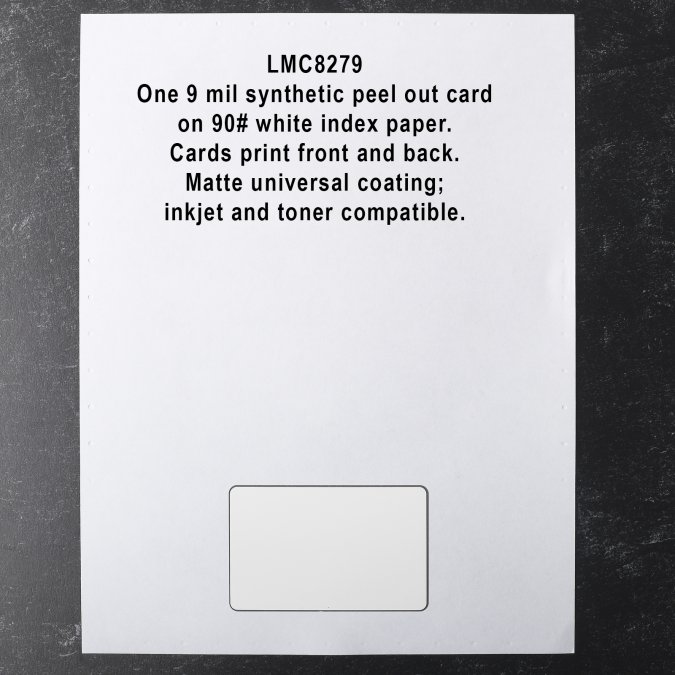
LMC8279 Inkjet and Laser Printer Compatible 9-mil Plastic Perforated Membership ID Cards
For membership cards, laser printing is a common choice. It's faster and works with a wide range of card stocks. Many organizations printing 500+ cards per month use laser printers.
Feature |
Laser Printers |
Inkjet Printers |
|---|---|---|
Speed |
40-60 ppm |
10-20 ppm |
Cost per Card |
Lower (toner) |
Higher (ink cartridges) |
Card Material |
Poly, paper-base |
Inkjet-coated stock and all paper |
Durability |
Excellent (permanent bond) |
Good (prone to smudging) |
Heat Risk |
High on thin cards |
None |
Duplex Support |
Yes (standard) |
Yes (slower) |
How to Print Membership Cards in a Small Office
Printing laser printer membership cards in-house requires the right equipment and workflow. Here's what actually works.
Start with a compatible laser printer. Check the printer's maximum paper weight specification. Most office lasers handle up to 110 lb stock, which is sufficient for 7-10 mil cards. Older printers may have lower limits. If planning to purchase a new desktop printer, make sure the printer you select offers paper settings such as “labels” and “transparencies” or “card stock”.
Next, configure your printer settings. In the printer driver, select "thick paper" or "cardstock" mode if available. Another available option might be “labels” or “transparencies”. Set the feed tray to manual if you're printing small batches, or use the regular tray for larger runs.
Design your cards. If you're using 1-up sheets (one card per sheet), position your design to account for the perforated border. If you're using 2-up sheets (two cards per sheet), make sure both cards are identical or clearly labeled so you don't mix designs.
Print a test sheet first. Feed one sheet manually and check for jams, toner adhesion, and alignment. If the card feeds smoothly and the print quality is sharp, you can proceed with batch printing.
For duplex printing, print the front side first then flip the stack and print the back. Carefully test auto duplex before printing a batch. Auto duplex turn and flip the paper which can lead to paper jams when printing specialty media with integrated substrates.
LMC8268-80N One Card 7-mil Plastic Peel →
Printer Compatibility and Card Material Specifications
Matching your printer to the right card material prevents jams, ensures clean prints, and extends printer life. In almost 20 years of experience, we commonly see Ricoh, Konica Minolta, Canon, Xerox printers in production settings successfully printing plastic integrated and embedded ID cards. HP is a good choice for desktop printers.
Getting Started with Your Membership Card Printing Solution
The fastest path to in-house card production is to start small, test thoroughly, and scale once you've proven the workflow.
Frequently Asked Questions
Can I use a regular inkjet printer for plastic membership cards?
Regular inkjet printers can work with specially coated inkjet-compatible card stock, but they're not ideal for high-volume production. Laser printers handle plastic membership cards more reliably and produce faster output. Inkjet cards require special film coatings to accept ink properly, and standard inkjet equipment may jam or produce inconsistent results with thicker synthetic materials. For consistent, professional results, laser-compatible membership card sheets are the better choice.
What are the benefits of using laser-compatible membership cards?
Laser-compatible membership card sheets offer several advantages: they work with most office laser printers, produce sharp, durable prints that resist fading, and handle high-volume runs efficiently. Laser printing fuses toner directly to the card surface, creating prints that withstand daily handling, moisture, and wear. These cards are tested in Xerox, Ricoh, Canon, and Konica Minolta printers, ensuring broad compatibility. They're also cost-effective for bulk orders, making them ideal for gyms, nonprofits, and corporate ID programs.
Does bulk ordering reduce ID card waste?
Yes, bulk ordering significantly reduces waste when you plan correctly. Ordering in larger quantities means fewer production runs, less setup waste, and better inventory management. When you buy integrated membership ID cards in bulk, price per sheet is drastically reduced saving money.
How do I choose between single-sided and dual-sided card printing?
Choose dual-sided printing if you need member information, or photos on both sides of the card. Most modern membership programs use dual-sided cards to maximize the space for branding and member details. Dual-sided cards are duplex printable, meaning your laser or digital printer can handle both the card and the carrier sheet in one pass. Single-sided cards work for simpler applications where only front-facing information is needed. Dual-sided printing provides professional appearance and additional functionality.